Wednesday, December 26, 2012

Motown 9


After the 1973 season the Tiger franchise crashed and burned.  For the next 4 seasons the team finished hopelessly below .500 as management began systematically purging the great players from their late 60's / early 70's teams and integrating youngsters.  1978 saw the franchise return to respectability.  With an influx of a core of young players, which included a keystone combo (Alan Trammell & Lou Whitaker) that would stick together for close to 2 decades, the Tigers were on their way.  Steady hand Ralph Houk oversaw the transition from the dying embers of a contender through the rebuilding process.  Detroit finished the season in 4th place with a 86-76 record.  After a fast start the young guns of Motown led the AL east by 1 game 2/3 of the way through May.  With Boston heating up the young Detroit team settled into a consistent pace that saw them fall 16 1/2 games out by late July.  Boston cooled off and the rest of the AL East did not quit.  The Tigers stayed competitive and as late as September 13th they were only 9 games out of first.  By season end the Tigers finished 13 games back, but their fans returned to Michigan and Trumbull and their team of the future was starting to really take shape.

What worked:  The Tigers led the league in OBP and came in 2nd in batting average, which translated to 5th in runs scored.  Apparently the youngsters could get on base, but could not drive in the big run when needed.  Their #1 draft pick that season, Kirk Gibson, would take care of that problem once he arrived in Motown in a few seasons.  Pinch hitters John Wockenfuss and Phil Mankowski were both clutch and great part time fill in's.  Lone holdover from their '68 Championship team, Mickey Stanley, even managed to hit .265 and come through in the clutch.  Whitaker and Trammell were stars right from the beginning.  You don't usually see this much polish in a pair of 20 year olds.  35 year old John Hiller had a great year as the team's closer.  Houk got over 200 innings out of his 4 main starters.

What didn't work:  The pitching staff was about average when compared to the rest of the league.  Other than Hiller (9-4, 2.34, 15sv) the bullpen was like kerosene on a fire.  The starting rotation did not have a true ace, unless you count 23 year old Jack Morris (3-5, 4.33), who was just learning his way through the league.  Jim Slaton (17-12, 4.12) and Jack Billingham (15-8, 3.88) were stop gap solutions.  Neither guy had #1 guy stuff and both relied on the offense scoring bushels of runs to be competitive.  Injuries plagued 3rd year phenom Mark "the Bird" Fidrych for the 2nd straight season.  If healthy, "the bird" was counted upon to be the ace of this staff.  He only managed to appear in 3 games and won both of his decisions.  No telling how far they go if he pitches close to his 1976 form.


In total I added 18 new cards for the '78 Tigers.


"Tram" finished 4th in the ROY voting at the conclusion of the '78 season.  His keystone partner  Lou Whitaker, won the award hands down.  The 20 year old Trammell played a fantastic shortstop and hit .268.  If Barry Larkin is in the HOF, this guy should be right next to him.  In a 20 year career he would hit .285 as a 6 time All-Star and 4 time Gold Glove winner.  In 1987 he virtually carried the Tigers yet lost out to George Bell for the MVP even though his team won the division by beating Bell's Blue Jays 6 out of 8 times over the final week.  He spent his full career with the franchise and never let his ego get in his way as he took a diminished role over the final 3 years of his career as he stuck around to tutor the next generation of Tiger youngsters.  If Al Kaline was Mr. Tiger for the 1950's-60's generation, Trammell is Mr. Tiger for the 70's-80's group.  Pictured here is his mid season 1978 Burger King card, which was obviously taken during spring training.

For most people Bob Sykes is a little known footnote in the annals of one sided MLB trades (the Yankees traded Willie McGee straight up for him).  For some in Detroit and in St. Louis he conjures up memories of a lefty hurler with much promise, who became a victim of arm trouble.  What Sykes really is is a hometown hero, who entered law enforcement late in life (age 50), who helps youths in his adopted hometown of Evansville, IN.  You can read the full story by clicking here.  Sykes' program works with kids from the time they are in Pre-K, so that they get to know each other and there is a healthy respect from both sides.  During the '78 season he compiled a 6-6, 3.94 record while splitting time between the rotation and the pen.

Taylor pitching 1 inning in just 1 game for the 1978 Tigers following a decent start in 1977 (1-0, 3.38).  He spent 41 games in AAA Evansville and compiled a 4-7, 4.57 record working solely out of the pen.  1979 would be his final season in professional baseball splitting time between Evansville and the parent club.  His 1-2, 4.82 record in 10 games with Detroit prompted the team to give his his release.  For a guy with such a short / unsuccessful major league tenure I was able to find more than a few autographed photos of him on the web, including this one.

Spikes was one of those "can't miss" prospects that came out of the Yankee farm system during the early 70's, when most of them "did miss".  New York traded him to Cleveland for Graig Nettles, who actually was a "can't miss" and the rest in Cleveland lore is history.  Spikes had 2 solid seasons, but blew out his knee and had discipline issues with Frank Robinson, who took over as Cleveland manager in 1975.  In 1978 he played in 10 games in Detroit and hit .250.  He spent most of the season languishing in Triple A (Evansville), where he was accused of loafing.  Bobby Cox, his former minor league manager in the Yankee chain, resurrected his career by bringing him to Atlanta where he did a great job as a pinch hitter for two seasons.  He moved on to play 1 season in the Japanese league before hanging up his spikes (all puns intended).  I found this autographed photo on ebay, which shocked me since he only had a 10 game tenure in Motown.

Stegman  played for Evansville for most of 1978, batting .264 . This earned him a promotion to Detroit when rosters expanded in September. In his MLB debut, Stegman appeared in 8 games, batting 14 times with 4 hits. In the next-to-last game of the season, Stegman hit his first major league home run on September 30 against the Baltimore Orioles.  The 1979 season looked a lot like 1978 for Stegman, as he spent the entire season with the Triplets, getting called up in September. This time, Stegman got more of a chance, appearing in 12 games with 33 at bats. Although he hit just .194, he did hit three home runs among his six hits.  In 1980, Stegman made the Tigers out of spring training. Serving as a reserve outfielder, he batted just .181 through August 6 before being set back to Evansville. He returned in September, but went just 2-for-14 down the stretch. After the season, he was traded to the San Diego Padres for relief pitcher Dennis Kinney.


Tobik made his Major League debut on August 26, 1978, giving up three earned runs in a 9-5 loss to the Milwaukee Brewers.  In 5 games with Detroit in 1978 he posted a 3.75 ERA, but did not have a decision   For 4 seasons he bounced back and forth between AAA Evansville and Detroit until he developed a forkball in 1982, which elevated him to closer status.  Manager Sparky Anderson was shocked that Tobik turned the corner, so to speak, and because he doubted it the franchise dealt him during the following spring training to Texas for Johnny Grubb.  Tobik had two average seasons in Texas and 1 sub par year in Seattle before leaving baseball.  Grubb went on to be a key left handed bat for the 1984 Detroit championship team.


Glynn spent 4 seasons (1975-78) shuttling between AAA Evansville and Detroit.  As a Tiger in 1978 he pitched exclusively out of the bullpen in 10 games.  He posted a 3.07 ERA and did not have a decision in 14 innings of work.  He was dealt to his hometown Mets during the following spring training.  His time with the Mets would last 2 seasons.  Next up would be 4 years spent shuttling between Cleveland and their AAA affiliate Charlestown.  Glynn kept on plugging away in the miors until he was 34, when he gave up baseball.  He returned briefly in 1990, at the age of 37 for a 1 game shot at Tidewater (AAA-NYM).  I found this photo doing a Google search.


Cactus Jack Billingham was the anchor of the Big Red Machine's pitching staff from 1972-1977.  After a sub par '77 season he was traded to the Tigers for two minor leaguers who never amounted to much.  In 1978 he was 15-8, 3.88 and in 1979 he was even better (10-7, 3.30).  Age caught up to him fast and by 1980 he bottomed out and retired.  His original 1978 card pictures him in a Reds uniform.  This is his 1978 mid season Burger King card.  The picture was taken during spring training after he came over to Detroit.


Arguably the best big game pitcher of his era, Morris was a 23 year old rookie who went 3-5, 4.33 for the Tigers during the '78 season.  It didn't take him too long to learn the league or his craft.  The following season (1979) he won 17 games and was well on his way to being the Tigers ace.  Morris is credited with being the winning-est pitcher during the 1980's.  The only knock on him was that he would pitch to the level of his competition, which inflated his ERA.  This might be one of the few reasons why he has been kept out of the HOF.  His 1978 card had him on one of those rookie panel cards with 3 other pitchers.  This card comes directly from the 1978 Burger King set issued mid season.


By 1978 "Catfish" Crawford was in his put up or shut up year.  After bouncing between AAA and the majors this 27 year old lefty was returning for his 3rd and final season in Detroit.  Crawford appeared in 20 games in 1978 and logged 39 innings with a 2-3, 4.35 record.  He was sent down to Triple A (Evansville), where hie was 1-3, 7.50, then given his release.  This photo was taken from his 77 card.


Slaton pitched just 1 season in Detroit (1978), which he sandwiched around his two extensive tours of duty in Milwaukee.  After 7 successful seasons in Milwaukee, where he was their staff workhorse he was traded to the Tigers for slugger Ben Oglivie.  Slaton won 17 games for the Tigers in '78, but he had a high ERA (4.12), so he was allowed to test the free agent markets.  Slaton went right back to Milwaukee and this time served as the staff's 5th starter / long reliever for 5 seasons.  He wound up back in Detroit in 1986 and retired after playing 22 games.  His 151-158 record doesn't do justice to a man who pitched his heart out for some really bad second division Brewer clubs.  His 1978 card pictures him as a Brewer.  This card comes directly from the 1978 Burger King set.


In less than two years, Young was inserted into the Tigers' rotation after the 1978 All Star break and immediately reeled off four consecutive complete game victories. He showed tremendous promise as the 1978 season came to an end, as he won six games, posted a 2.81 ERA and had seven complete games. It appeared that Young was an excellent candidate for the Tigers starting rotation in 1979. However, inclement weather in the first month of the year allowed only two appearances and Young struggled with his control. He was sent to Triple-A Evansville to get some work in and when he returned, Sparky Anderson was named new manager of the Tigers.  Young was unable to find a spot on the Tigers pitching staff and struggled as both starter and reliever. It would prove to be the final campaign of Young's brief, two year career. He would pitch at the minor league level for two more years before finally calling it a career. (This synopsis was furnished by 1980ToppsBaseball blog).  The photo comes from a Google search

Parrish became the cornerstone of the Tiger franchise during the late 70's and through the mid 80's.  He was the top ranked catcher in the AL both offensively and defensively.  Manager Sparky Anderson thought he was "too bulky", because he was one of the early proponents on lifting weights.  During his 10 year stay in Detroit he was a 6 time All-Star and 4 time Gold Glove winner.  In 1978 he hit just .219, but he did power 14 homers in less than 300 at bats.  After the 1986 season the Tigers deemed him expendable due to th emergence of Matt Nokes behind the plate.  He signed with Philadelphia and made 2 more All-Star teams.  During his 10 years in Detroit he hit 212 of his 324 homers.
Interesting Tidbit:  He was the last cut by the 1993 Dodgers, who elected to keep this prospect named Mike Piazza.


Whitaker, the 1978 AL ROY, was all that he was advertised to be.  Compare his lifetime numbers to Joe Morgan's and tell me why he is not in the HOF ?  I can't answer that question.  During the '78 season this 21 year old rookie hit .285 and was rock solid in the field.  For the next 17 seasons he never led up and actually hit .293 in his final season.  During his career he was a 5 time All-Star, 4 time Silver Slugger and 3 time Gold Glover.  How only 3% of the voters chose him for Cooperstown is mind boggling.  This card comes from his 1978 Burger King card.


Wagner spent 3 seasons backing up Whitaker and Trammell and hoping to get some sort of break.  He was 4 years older than both and a light years worth of skill behind them.  In '78 he got into 39 games and hit .239.  The following season he hit .274 in 75 games backing up the infield.  By 1980 his playing time and his average dipped into the .230's and he was moved along to Texas.  Wagner lasted as a utility man until 1984, where he finished up his career in 1984 for Oakland hitting .230.  During that season he actually got to pitch 1 2/3 scoreless innings vs his old Tiger teammates.  A couple of subpar seasons in Triple AA later signaled his exit from baseball.  At the age of 43 he made a 2 game comeback with Cincy's Double A affiliate Chattanooga, where he went 1 for 4.  This photo came from his '82 Donruss card.


Burnside debuted on September 4, 1978 with the Tigers against the New York Yankees. His debut was rough and he posted a 0.1 IP, 3 H, 0 SO, 2 BB, 4 ER line for the night. On October 25, 1979 he was traded by the Tigers to the Reds for Champ Summers. His last appearance was in 1980 for Cincinnati.  Burnside was one inning away from never even advancing out of A ball.  Click here to read an interesting article on what turned his minor league career around. I found this B&W photo, while doing a Google search and colorized it.

After spending part of the 1978 season in the minor leagues, Baker made his major league debut on May 25, 1978. In a contest against the Baltimore Orioles, he pitched 6⅓ innings, striking out six and allowing one earned run as the Tigers lost to the Orioles, 2–1.  Baker made 15 appearances for the Tigers, starting ten games, earning two wins, four losses, and an ERA of 4.55.  Baker also made 16 appearances for the Evansville Triplets, the AAA-level minor league affiliate of the Tigers. In those appearances, Baker made 16 starts, won eight, lost one, threw four complete games, three shutouts, and earned an ERA of 3.21.  Baker began the 1979 season as a part of the Tigers' rotation as a spot starter. He played 21 games, starting 12 of them. After posting a 1–7 record and a 6.64 ERA, he was sent back to Evansville.  After spending nine games with Evansville in 1980, he was purchased by the Toronto Blue Jays on June 6, 1980.  I colorized this B&W photo and superimposed it on a Tiger Stadium background.

After 3 seasons in Boston as a utility man Dillard was sent to Detroit in exchange for two minor league prospects. For his new team, he provided solid support for young infielders Lou Whitaker (2B) and Alan Trammell (SS).  He played in 56 games, but hit just .223. During the 1979 spring training he was moved by Detroit to the Chicago Cubs, spending three seasons with them. His most productive season came in his first year at Chicago, when he hit a career-high .283 batting average with five home runs and 31 runs in 89 games played. The following season he posted career-numbers in games (100), hits (55), doubles and RBI (27).  This is his 1978 Burger King mid season update card.

Pale Hose

The South Side Hit Men were no more.  Just a 1 year experiment by the enterprising Bill Veeck was disbanded by this new phenomenon of the 1970's called Free Agency.  Veeck's idea was to collect as many long ball threats as possible who had expiring contracts and let them hit homers in hopes of netting a huge free agent deal.  In the process the Chisox contended for the AL West flag and kept the South Side fans enthralled.  In contrast the '78 edition of the Pale Hose had one 20 homer man (Eric Soderholm) and a bunch of singles hitters.  Jorge Orta and Chet Lemon (13 homers each) were the only others to eclipse double digits.  Lemon, who played a mean centerfield, was the only regular to hit .300, which he did on the nose.  Chicago had a superb bench.  The top 6 guys off the bench hit over .260.  Wayne Nordhagen, who played practically every spot, hit .301 in 206 at bats.  The Chisox were 10th in the league in runs scored, which didn't bode well for a team who's pitching staff finished 12th out of 14 teams.  Not one starter had an ERA under 4.00.  Veteran knuckleball ace, Wilbur Wood, hit the skids.  After years of being the staff ace in both innings and 20 win seasons Wood posted a meager 10-10, 5.20 season.  If the starter managed to hold up, the pen would find a way to blow it.  Twin closers Lerrin LaGrow and Jim Willoughby each had high ERA's a a penchant for blowing late inning leads.  Seldom used Mike Proly (5-2, 2.74) was the only reliever to post a sub 3.00 ERA.  Still there was a glimmer of hope with a pair of 19 year old on the horizon in Steve "Rainbow" Trout and Britt Burns.  Both saw very limited action, but would become the future of the franchise.  1978 was a rebuilding year as the Pale Hose finished 71-90, 20.5 games behind the division winning Royals.

In total I created 25 new cards for the White Sox, which up to this point is the most that I had to create for any one team for this project.

On September 8, 1977 the Chisox selected Nahorodny off waivers from the Philadelphia Phillies.  For a small cash investment they got their starting catcher for the next 2 seasons.  Nahorodny hit just .236 in '78, but he did catch 107 games for a team that needed help behind the plate.  I found this autographed photo on ebay.

Molinaro was selected off waivers by the Chicago White Sox from the Detroit Tigers  He would see action in just four games for the White Sox in 1977.  Molinaro returned to the majors for a full season with the White Sox in 1978, before heading back to the minor leagues for the 1979 season, which saw him play for the American Association's Iowa Oaks. Molinaro did have another brief stay in the major leagues in 1979 when he played eight games for the Baltimore Orioles. Once again, he was back in a White Sox uniform, and playing full-time for them in 1980 and in 81.
After two years with the Chicago White Sox, Bob Molinaro was sent by the Chicago White Sox to the Chicago Cubs on March 29, 1982 to complete an earlier deal.  In '78 he played all 3 outfield positions and hit .262.  The photo here is his 1980 supersize card photo

Bonds just looks a bit warn out and a lot troubled when he took this photo.  Maybe he was just told that he was traded for the 5th time in 5 years.  Who knows.  What we do know is that here before you stands one of the most disrespected 5 tool players in the history of the sport.  Bonds, who arrived in an offseason trade was gone just 26 games into the '78 season.  Chicago sent him to Texas in exchange for Claudell Washington and Rusty Torres.  He managed to hit a respectable .278 with 2 homers in his short stint on the South side.  I found this whole card on the Whitesoxcards Blogspot site.


19 year old Britt Burns was drafted in 1978 by the Chisox in the third round of the amateur draft.  He was given 2 starts and performed just like an over matched teenager.  He would spend the better part of the next 2 seasons learning his craft in the minors before his 15-13, 2.84 rookie season in 1980, where he finished 5th in the ROY voting.  Burns would win in double digits for the Chisox in 5 of the next 6 seasons before developing serious arm trouble.  He was traded to the Yankees before the start of the 1986 season, but was damaged goods.  Besides arm issues he also developed hip problems, which forced him to retire at the tender age of 26.  In 1990 he attempted a comeback in the Yankee farm system, but that ended when he appeared to be a shell of his former self.  This photo came from his supersized 1980 card.

Washington, who arrived in the early season Bonds trade, struggled heavily in 1978.  He was hitting just .167 with Texas befor the trade and hit just .264 the rest of the way in Chitown.  Curiously he did not steal many bases (5) for the White Sox that season even though he had stolen 40, 37 and 21 in the 3 previous seasons.  Washington, who was rushed to the majors by the A's at the tender age of 19, never fully developed into the player that he was expected to be.  He had flashes of power and speed, but never put it all together in a 20/20 or 30/30 type season that he was expected to have.  His best season (1975) occurred when he was a 20 year old playing for the Oakland A's.  He posted career highs in average (.308) and stolen bases (40).  He would go on to play for 7 franchises during his 17 year career.  Interesting Tidbit:  A foul ball that he hit on 6/15/85 at Wrigley was featured in Ferris Buheler's day off.  Ferris caught the ball.  I found this autographed photo on ebay.
Pryor's claim to fame is that he was the last draft pick ever by the Washington Senators to play in the majors.  Since the Sen's moved to Texas, he never played in Washington.  Pryor finally made the majors for good as a 28 year old rookie in 1978, where he played every position in the infield and hit .261 in 222 at bats.  Pryor acquitted himself quite well as a utility man with a functional bat for 4 seasons in Chicago, before moving to KC for the final 5 years of his career.  In KC he won a World Championship in 1985.  I used Pryor's Donruss card photo for this updated '78 card.
Chappas, who measured 5' 3" was another Bill Veeck favorite who wound up being exploited as only Mr. Veeck could do.  Obviously not as short as the midget Eddie Gaedel, but still useful for publicity Chappas appeared in just 27 games for the '78 Chisox and hit .267.  The following season he was featured on a Spring Training Sports Illustrated cover photo (used here for this card).  Veeck got about as much mileage as he could from Chappas, who won the starting shortstop job in Spring Training, but eventually lost it due to performance 2 weeks into the season.


Kucek spent 5 seasons splitting time between the Chisox and their AAA affiliates.  The most time he spent with the Sox was in 1978, where he appeared in 10 games and started 5.  3 of those 5 starts wound up as complete games.  Kucek logged 52 innings and finished the year with a 2-3, 3.29 record.  He was traded to Philly midway through the following season and finished his career in 1980 at the age of 27, while with Toronto.  Kucek's 1979 card photo appears here.


Breazeale played four seasons in the Major Leagues, three with the Braves (1969; 1971–1972), and one for the Chicago White Sox (1978). In his MLB career, Breazeale played 89 games with 179 at bats and 40 hits. He had three home runs, 33 RBIs, 20 runs, and a .223 batting average. He played his final game on July 19, 1978 with the White Sox.  Known for his huge horn rimmed glasses, Breazeale hit .208 with 3 homers in 72 at bats for the South Siders during his brief stay there.  He was a rule 5 draft pick from the Braves organization.  Rather than release him after the '78 season the White Sox made him player manager of their Appleton (A ball) affiliate, where he hit .305 in 1979 and managed the team.  This B&W phot required heavy colorization and customization.  I then superimposed it on a Comiskey background.


During his 8 year career Willoughby played for the Giants (1971-74), Red Sox (1975-77) and finally the White Sox (1978).  During the '78 season he posted a 1-6, 3.86 recore with 13 saves in 93 innings.  At the end of the season he was traded to the Cardinals for John Scott, but never played another game in the majors.  The Cubs picked him up as a free agent and assigned him to their AAA affiliate (Wichita).  After a poor half season in Wichita he was cut and picked up by Portland (AAA-PIT) and in 24 games he went 3-2, 2.85, but never received a call up.  He was released at the end of the '79 season.  I used his '79 card photo, which was taken during the '78 season at Yankee Stadium.


Gates played parts of two seasons in the majors for the Chicago White Sox.  His only extra base hit was a triple on May 13, 1979 against the Kansas City Royals. He had come on as a pinch hitter for Don Kessinger and stayed in the game and played second base. The pitcher for the Royals was Eduardo Rodriguez. The hit drove in Greg Pryor in the bottom of the 9th. The final score of the game was Royals 14, White Sox 5.  After his major league career, he entered the coaching ranks, where he coached many teams over the course of a 30 year period until his untimely death at the age of 55.  This card was created off a B&W photo that I colorized, then added the SOX logo on his batting helmet and pasted on a 1978 White Sox jersey picture that I found while doing a Google search.

Named Larry Doby Johnson, after the first African American to play in the American League.  Johnson appeared in just 12 major league games in 5 partial seasons for 3 different franchises (Cleveland, Montreal and Chicago).  He hit .125 (1-8) in his short tenure on the South side.  Johnson spent over 15 seasons as a minor league catcher and had a lifetime .266 average in MiLB.

Interesting Tidbit:  Larry Doby himself was a coach on all 3 teams that Johnson played.  He was released 5 weeks prior to Doby being named White Sox manager.  This photo comes from his minor league card, while at Rochester.  I had to airbrush out the team logo on the jersey and change the colors to be consistent with White Sox blue.  I added the SOX cap logo.  Not many photos of Johnson are available.

In April 1976, the Tigers sold LaGrow to the St. Louis Cardinals. LaGrow pitched in 8 games for the Cardinals with a 1.48 earned run average.  During 1977 and 1978, LaGrow moved to Chicago and became their ace reliever. He appeared in a career high 66 games for the White Sox in 1977 and another 52 in 1978. In 1977, he had 25 saves for the White Sox, third best in the American League. He was also among the league leaders in saves in 1978 with 16.  This is his original '78 card, which for some reason wasn't part of my original packet, so I wound up including it here.

Interesting Tidbit:  In the 1972 ALCS, while pitching for Detroit, he threw at Bert Campaneris and hit him in the ankle, which set off a team brawl and got both players suspended for the rest of the series.


After the 1978 Triple-A season ended, Foley was given his first taste of major league action. He made his debut on September 11, 1978 against the Minnesota Twins. He pinch-hit for starting catcher Mike Colbern in the 9th inning, grounding out against pitcher Mike Marshall.  He played in a total of 11 games that season, batting .353 in 34 at bats.  Over the next 2 seasons Foley saw his playing time increase and his batting average decrease.  He spent all of 1981 and 1983, and most of 1982 in the minors.  1984 saw him play in 63 games as a Texas Ranger, but that was his final taste of the biggs.  I found this great close up photo of the Chicago White Sox Cards blog.


Colbern saw action in 48 games for the Pale Hose during the '78 season.  He hit .270 (38-141) with 2 homers and 20 RBI's.  The following season he slumped to .241 and was send down to Iowa (AAA), where he was only slightly better (.246).  1981 was a hard year for Colbern.  He hit .264 during the first half of the season, but did not get called up due to the MLB Players Strike.  Instead he was traded to Atlanta's Richmond AAA affiliate where he hit .150.  Instead of being promoted to the majors he wound up demoted to AA Savannah.  He hit just .235 and was given his release.
Interesting Tidbit:  He was part of a class action suit by former major leaguer's who didn't qualify for the player's pension fund.  They claimed that they were entitled to a pension just like Negro League players, who played sparingly in the majors.  They did not win their case.


In two major league seasons, Eden posted a .080 batting average (2-for-25) and scored a run in 15 games. He hit .269 (251-for-932) in 266 minor league games, including 16 home runs, 114 RBI, and a .363 on-base percentage.  In 1978 he appeared in 10 games as a utility player and hit .118 (2-17).  In 106 games at Iowa (AAA-CHW) during the '78 season he hit .274 (113-412) and hit his minor league career high in homers (7).  After the season concluded he was released by the Chisox and picked up by Baltimore, where he was assigned to Rochester (AAA).  He played 2 non-descript seasons in Rochester before being released.  I found this photo while doing a Google search.


Proly finally got a chance to be a full time major leaguer by the Sox in 1978 after spending most of the previous 6 seasons in the Cardinal chain.  Proly received a battlefield promotion from Iowa after impressing the parent club by going 6-2, 2.59 in 22 games.  His magic continued on the major league level.  In 14 games (6 starts) he went 5-2, 2.74.  The following 2 seasons saw him have limited success as both a long reliever and spot starter for the White Sox.  After a disappointing 1980 he moved on to Philly and played 1 season there + 2 additional seasons with the crosstown rival Cubs before being optioned back to the minors.  I found this autographed photo on ebay.

Squires was a great glove man who just didn't hit for enough power to become the team's regular first baseman.  His 6 homers in 10 big league seasons can attest to that.  After 5 seasons in the Chisox minor league chain he was given a chance in 1978 to play for the big club.  he hit .312 in 115 games at Iowa (AAA) during the '78 seasons.  He hit .280 in 150 at bats for the parent club once he was called up from Iowa.  Squires would play all 10 of his major league seasons in Chicago for the White Sox.  this autographed photo was found on ebay.
Interesting Tidbits:  In 1984, the lefty throwing Squires, played 13 errorless games at third base.  In 1981, his only season as a full time starter, he won the Gold Glove Award at first base.

Torrealba bounced around the Braves farm system for 8 seasons getting to finally play with the big club in 1976.  His contract was sold to the A's at the conclusion of Spring Training and he proceeded to have a phenomenal '77 season in Oakland.  Almost a year to the day that he moved to Oakland, he was dealt to the Chisox for Jim Essian and Steve Renko.  Oakland got the better end of the deal as Torrealba went 2-4, 4.71 in 25 games.  Midway through the '79 campaign he was sent to the minors then released.  I used his '79 card photo.


Hinton was the epitome of the journeyman righhander who had AAAA stuff and bounced around from team to team.  The White Sox must have really taken a liking to him, because he was acquired by the franchise on 3 separate occasions.  Originally drafted by Chicago in 1969 he played 1 season (1971) for them before moving over to the Yankees and Texas.  He spent all of 1973 and 1974 in the minors before returning the Chisox for 15 games in 1975.  1976 saw him earn a ring in Cincinnati, even though he did not add anything productive to the team's accomplishment (1-2, 7.64).  A comeback in 1978 saw him return to Chicago for a 3rd tour of duty where he pitched in 29 games (80 innings) and posted a 2-6, 4.02 record.  He must have showed the Chisox enough to be invited back in 1979, but after going 1-2, 6.05 in 16 games he was sent to Seattle, where he finished out the year and his career.  This photo is one of my favorite.  I took a photo fo him on the Yankees and airbrushed the cap and added the SOX logo then superimposed a White Sox jersey over his Yankee threads.


In 1978, Wortham opened the season in Iowa. However, when starting pitcher Ken Kravec got off to a rough start, he was sent to the minors, and Wortham was called up to replace him. He made his debut on May 3 against the Milwaukee Brewers, and he pitched 6.2 innings and gave up 3 runs in a 4–0 loss.  In his next start, he beat the Minnesota Twins, pitching 8 innings and giving up 2 runs on 9 hits.  His next outing found him giving up 10 hits in just 4.1 innings, and he was returned to the minors, with Kravec returning to the majors.  Wortham spent most of the rest of the season in Iowa, and was recalled in September when the rosters expanded. In five September starts, Wortham went 2–0 with a 2.70 ERA, lowering his overall ERA for the season to 3.02.[3] He also pitched his first two major league complete games. Wortham was seen as a future star.  That star would quickly dim in 1979 after he posted a 14-14, 4.90 record.  1980 was even worse, which facillitated him being farmed out.


While pitching for the White Sox's Appleton minor league club in 1978, Baumgarten was 9–1 with a 1.82 earned run average (ERA) as a starting pitcher, and earned promotion to the White Sox major league club.  In limited action (7 games) he went 2-2, 5.87 for the parent club.  The following season he started 28 games and did very well (13-8, 3.54).  1980 saw his ERA drop 10 points (3.54), but his record plummeted to 2-12.  1981 saw his record improve modestly (5-9), but his ERA went over the 4.00 mark.  On March 21, 1982 he was shipped to Pittsburgh for Vance Law and Ernie Camacho.  In 12 games in Steeltown he dropped all five of his decisions to go along with a 6.55 ERA.  The Pirates cut him, but he got a last chance with the A's who's complete pitching staff was decimated by Billy Martin.  In Tacoma AAA he was just as bad as he was in Pittsburgh the previous year, so he was released.  I found this photo while doing a Google search.


Torres was signed on March 1, 1978 by the Texas Rangers. Torres started 1978 back in the minor leagues for the first time in three years, playing for the Tucson Toros. He got off to a hot start, batting .346 with 7 home runs in just 30 games. On May 16, Rusty was traded again to the Chicago White Sox along with Claudell Washington for, Bobby Bonds. After spending a few months with the minor league Iowa Oaks, Torres earned another shot at the majors in September. In 16 games down the stretch, Torres managed to hit at a .316 clip in 44 at bats.  He was with the Chisox again in '79, but hit just .253 and left for KC via free agency in 1980.  I used an autographed photo found on ebay.
Interesting Tidbit:  Torres played a pivotal part in MLB's 3 forefits during the 1970's.  1st as a Yankee during the Senators final game in 1971, then as an Indian on 10 cent beer night in 1974 and final as a White Sock during Disco Demolition night on July 12, 1979.


Trout was drafted by the Chicago White Sox in the first round of the 1976 draft.  He played three years in the minor leagues before joining the White Sox and pitching in his first big league game on July 1, 1978 against the Minnesota Twins.  In 3 starts (4 total games) he went 3-0, 4.03 for the '78 Pale Hose.  As a 21 year old rookie he went 11-8, 3.89 in 1979.  He would remain on the Southside until 1983, when he headed north to Wrigley to play the Cubs for 5 seasons.  Trout never reached the potential that the pundits forecasted for him.  He did cobble together a 12 year career as one of baseball's dizziest lefties.  I found this great autographed action shot via Google search.


Bosley was traded in the off-season to the White Sox with Richard Dotson and Bobby Bonds. He remained with the White Sox organization for three years and later played for the Milwaukee Brewers, Seattle Mariners, and Chicago Cubs, distinguishing himself as one the best pinch hitters in the majors. During the 1985 season, Bosley hit .328 and was voted the best pinch hitter in baseball.  During the '78 season he hit .269 in over 200 at bats.  Throughout his career he was a solid clutch performer, who didn't have enough pop to play as a regular corner outfielder.


Spencer managed three teams to their respective league minor league championships: the Asheville Tourists (1984), Geneva Cubs (1987), and Charlotte Knights (1997).  His major league playing career consisted of  29 games with the Chisox in 1978.  In 65 at bats he hit .185.  He played all 3 outfield spots.  During his 12 minor league seasons as a player he was a solid .272 hitter who never displayed much power.  In 1974, while with Cincy's Indianpolis AAA affilite he hit 14 homers, which was the only time he posted double figures in his career.  He spent most of '78 at Knoxville (AA-CHW) and hit .331 in 81 games before being recalled to Chicago.  i took this B&W photo and colorized his jersey and cap.

Tuesday, December 25, 2012

The Tribe

Welcome to the 1980's baseball version of Siberia.  Someone once said, "Pennant Fever" in Cleveland last approximately 48 hours".  Some baseball pundits believed it didn't even last that long.  By 1978 The Tribe was entrenched in a streak of finishing below .500 for 15 of the previous 20 seasons.  That's a record of futility only since past by the Pirates (circa 1993-2012).  A 1970's Cleveland Indians team was usually comprised of players on their way up (and probably out via trade) and those on their last legs.  Sprinkle that in with some fringe major leaguers and career minor leaguers and you have 48 hours of pennant fever.  This team finished 66-90 and stayed out of last place thanks to the generosity of the second year expansion Jays. 28 year old 1B-DH Andre Thornton, who bounced around the NL and was getting his final chance made the most of it leading the team with 33 homers and 105 RBI's and being well on his way to becoming a forgotten Tribe legend of this era.  No one else eclipsed the 20 homer mark.  Newly acquired Gary Alexander hit 17 and Johnny Grubb had 14.  The rest of the team barely found the warning track.  Shockingly the Tribe finished 8th (middle of the road) in homers hit, despite being quite top heavy with 3 guys carrying most of the load.  Jim Norris (.283) was the closest this team came to a .300 hitter.


To their credit though, the team did bat .262 and most of the lineup, except Alexander, hovered close to that average.  The bench was solid.  Not a lot of pop, but they were all capable of getting a big hit if by miracle the team was in a close one.  The pitching was close to awful.  Rick Waits (13-15, 3.20) and Mike Paxton (12-11, 3.86) were the only starters with ERA's below 4.00.  Waits had a fantastic year, which also included 15 complete games and 2 shutouts, but more often than not his offense couldn't score for him.  The key here is to get to the pen, which was the real strength of this team.  Jim Kern (10-10, 3.08, 13sv) was the closer.  Paul Reuschel (2-4, 3.11), Sid Monge (4-3, 2.76, 6sv) and Dan Spillner (3-1, 3.67, 3sv) did a fantastic job setting up Kern.  The challenge will be:  can Cleveland hold a lead into the late innings and hand it off to the pen ?

To round out the "missing Indians" cards I added 20 new 1978 Cards that required various degrees of work.


20 year old Griffin hit an amazing .500 for the Tribe.  Unfortunately that came in just 4 at bats.  1978 would mark the final cup of coffee with the Tribe for this slick fielding / switch hitting shortstop  who would go on to win the 1979 ROY Award in Toronto.  On December 5, 1978 the Tribe would make another one of their bonehead trades by sending Griffin to Toronto for Victor "not the Salsa dancing WR" Cruz.  This card was a fun one to make.  I took an early B&W photo of Griffin and colorized it along with adding the "C" on the cap.  I then superimposed it on a background of Municipal Stadium.
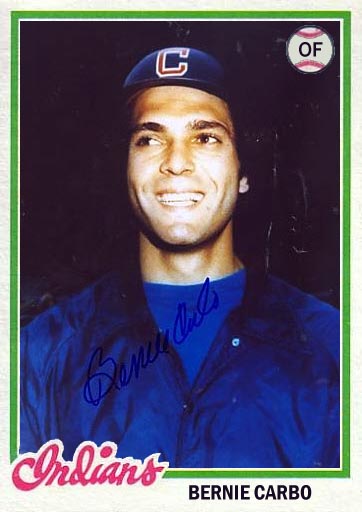
One thing Bernie Carbo could do was hit.  Unfortunately for him and the 6 franchises that he played for during his 12 seasons, he took more bong hits than bat hits.  Carbo spent just 60 games in Cleveland during the '78 season, splitting time with Boston.  He hit a respectable .287 with 4 homers in 174 at bats as the team's DH after arriving on June 15th.  At the end of the season he was given his free agency as he slipped further and further into the abyss called drug abuse.  He will forever be remembered for that huge World Series Homer that he hit in 1975 during that historic game 6.  I used an autographed photo found on ebay for this card.
Bo was another tragic figure.  Tragically he died at the young age of 37 while adjusting a satellite dish on his roof.  He played 13 big league seasons and was a 2 time All-Star.  In 1978 he caught 44 games for the Tribe and hit just .236.  Limited success for him over the next two seasons was followed by a breakout year in 1981, where he hit .313 and was the AL-All Star catcher.  At the conclusion of the season the Tribe once again dipped into their bad trade bag of tricks and packaged him in a 3 team deal that netted Silvio Martinez and a beat up Lary Sorensen.  Diaz went on to have a fine career in Philly and Cincy.  I used his '79 Card photo for this card.

Briggs hit just .163 in 15 games with the Tribe during the '78 campaign.  The Tribe wisely dumped him on the Padres, who used him in '79 as a utility man who hit .207 in 227 AB's.  After spending all of 1980 in the minors he would get two final cups of coffee in 1981 (Montreal) and in 1982 (Cubs) before realizing that a career .195 hitting utility player doesn't have too many major league options.  I used his '79 card here.


Spillner arrived from San Diego mid season in a deal for Dennis Kinney.  Score this deal as one of the few "wins" for the Tribe.  For the next 6 1/2 seasons he would serve whatever roll their staff needed.  His best season (1982) was as the team's long man / closer.  He went 12-10, 2.49 with 21 saves.  At the age of 32 after a 4-3, 3.44 season out of the pen in Chicago he wasn't offered a contract by anyone, so he retired.  A strange sequence of events showed that he was a victim of baseball's "Collusion" of the mid 80's and later award a cash settlement of almost $450,000.  If you want to read a great "Where are they now" article about him from SeattlePI, click here.  I found this autographed photo on ebay.

Former #1 pick of the Texas Rangers, Clyde was damaged goods when he arrived on Lake Erie.  In 1976 his arm troubles began. Traded to the Cleveland Indians in 1978, he was 8-11 and then 3-4 before he damaged a rotator cuff.  He was out of baseball at the age of 24 in 1980 having never fulfilled the promise of being a phenom.  Clyde was purely a victim of poor ownership (Bob Short) and poor management (Billy Martin) in Texas.  The NY Times wrote an interesting piece on him 10 years ago.  You can read it by clicking here.  I found this photo on ebay.

Kinney was selected by the Cleveland Indians in the 10th round of the 1970 Major League Baseball Draft, and he played in their organization through his major league debut in 1978. He was given a chance at closing games for the Indians, notching five saves in 18 games. That June, however, he was traded to the San Diego Padres for pitcher Dan Spillner.  Kinney's one full season in the majors came in 1980 for the Padres. That year, he pitched in 50 games as a reliever, compiling a 4–6 record with a 4.25 ERA and one save. In December, he was traded to the Detroit Tigers for outfielder Dave Stegman, but appeared in just six games for the Tigers before being released in the offseason. After a brief trial with the Oakland Athletics in 1982, his major league career was over.  I did some airbrushing and cut/pasting on this minor league card photo.

Alexander arrived in a trade with the A's on June 15th for Joe Wallis.  At the time many thought the Tribe finally swindled someone else in a trade.  With his combined numbers Alexander came in 9th in the AL in homers (27), but he also led the league with an alarming 166 strikeouts.  Still, he was a catcher with power, and how can you go wrong with that ?  If you are Cleveland, you could find a way to go wrong with anything.  It turned out that Alexander was a huge defensive liability behind the dish leading the league in errors.  He was eventually replaced by Ron Hassey mid way through the following season.  He was relegated to the DH role, but hit just .225 with no power and was eventually replaced by rookie phenom Joe Charboneau in 1980.  I found this photo while doing a Google search.
No one had a more appropriate name than Horace Speed.  This man could flat out run.  Known throughout his short career as a pinch runner / 5th outfielder, Speed saw extended action  in '78 for the Tribe.  His .226 average was not overly impressive.  His 4 "caught stealing" in 6 attempts was even more alarming for a man who made his living with his legs.  1979 saw him hit just .143 in 26 games before being farmed out for good.  I found this rare photo of him on the OOTP board.
Lintz is a MLB record holder.  I bet most folks, including myself, didn't know that.  Apparently he holds the record for most steals in a season (31) for a player who didn't actually record a hit (0).  An amazing obscure record set in 1976 as a member of the Oakland A's, who were trying to put together one final run before owner Charlie Finley dismantled his team.  Lintz had some moderate success as a speedy middle infielder for the post-expansion Expos in the early 70's.  By the time he got to Oakland he was purely a specialty player.  By 1978 he found himself playing in Portland, which was Cleveland's AAA affiliate.  The Indians called him up for a few games where he served as a pinch runner.  No know photos of him could be found in an Indian uni.  I took his 1975 SSPC card photo, as a St. Louis Cardinal, and pasted the CLEVELAND jersey logo on it.  No hat was needed, because there is no reason to cover up a cool 'fro like his !

Paxton arrived in the offseason as part of the Eckersley deal.  He had an above average (12-11, 3.86) first season in Cleveland and fans were just about to forget "the Eck", but unfortunately he bottomed out in 1979 (8-8, 5.92) and then disappeared for good after a forgettable 1980 (0-0, 12.91).

Vail was a big time rookie who burst on the scene in 1975 with the Mets.  He immediately set the rookie consecutive game hitting streak record (23 games).  Based on his limited body of work in September the Mets anointed him their "Player of the Future" and traded fan favorite Rusty Staub to Detroit.  Vail rewarded the Met brass by breaking his foot in the off season while playing basketball. The injury robbed him of whatever speed he had and he was never the player they thought he'd become.  His stock fell so much the Tribe claimed him off of waivers at the end of Spring Training in March of 1978.  In just 14 games on Lake Erie he hit .235 and was sent to the Cubs for Joe Wallis at the June 15th Trade deadline.  I took this Cubs photo and added an Indian jersey, red rim on his cap and a "C" logo.
It's not hard to spend your life pitching in the large shadow of your brother, especially when your younger brother was larger than life (figuratively and literally) Rick Reuschel.  Paul, who looked more like an accountant than a major league hurler, was traded by the Cubs to Cleveland midway through the '78 season.  He responded with a respectable year out of the pen.  1979 proved to be a horrendous year for him (2-1, 7.94) and he was subsequently released.  I used his '79 card photo.
I doctored up a B&W Red Sox photo of Kreuger and added the appropriate logos and trim, then superimposed it on a background of the "Mistake by the Lake".  At 29 he was all out of options and was released by the Tribe.

Rick Wise won 188 games in a solid 18 year career in the big leagues, yet we will all remember him as the guy that was traded for Steve Carlton.  At the time, 1972 most pundits though of Carlton as being slightly better than Wise, but definitely on a par with him.  Looking at their numbers after 1972 it is easy to see who got the better of the trade.  Wise had some realy good years in Boston, culminating in his 19 win sesaon of 1975.  By the time he got to Cleveland his skills were beginning to errode.  1978 saw him lose 19 games for the Tribe, which also led the league in futility.  He rebounded nicely in 1979 (15-10, 3.73), but that turned out to be his final season as a front line starter.  After the '79 season the Tribe let him become a free agent, which turned out to be the correct move since he had 3 sub par years in San Diego.  I found this autographed photo on ebay.


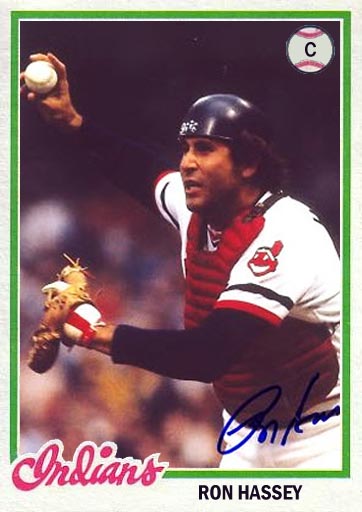
Hassey was a 25 year old rookie for the Tribe in '78.  He hit just .203 with 2 homers in 74 at bats.  The following season would see him become part of the lefty/righty platoon behind the plate with Bo Diaz.  He responded favorably by hitting .287.  His best season in Cleveland was 1980, where he hit .318 with 8 homers in 390 AB's.  In total he would spend 7 above average seasons with the Indians.  He had some solid seasons up in the Bronx and on the South Side of Chicago before moving on to Oakland and playing on 3 pennant winners as the lefty part of their catching platoon.  I found this great autographed action shot on ebay.


Cox turned out to be one of your run of the mill banjo hitting utility players.  In 82 games in '78 he played 5 positions and hit just .233 in 227 AB's.  He pretty much duplicated those numbers in '79 before being traded to Seattle for Bud Anderson.  After one carbon copy season in Seattle he moved on to Toronto, where he hit .300 in just 50 AB's and was never heard from again as he was banished to the Mexican Leagues.


Veryzer batted .271 with one home run and 32 RBIs in part tie action during the '78 season. His most memorable moment of the season may have come on September 13 when he drove in the winning run of the Indians' 2-1 victory over the Boston Red Sox with a successful suicide squeeze bunt, knocking the Red Sox out of first place.  He would spend 4 seasons as the Indians starting shortstop before moving over to the Mets.  I found this photo while doing a Google search.

In 1971 Cage was drafted by the Cleveland Indians. Although Cage was with the Indians organization until 1981, he only played in the major leagues in 1978 and 1979, when he had batting averages of .245 and .232. He was traded to the Seattle Mariners in 1981 for Rod Craig, although he would not play in the major leagues with Seattle. Instead, a week after the trade, Cage's contract was sold to the Hankyu Braves of the Japanese Pacific League. He played for the Braves for two seasons, 1981 and 1982.

Horton, who split the '78 season with 3 horrible teams, started the year as the Tribe's starting DH.  In 50 games he hit just .249 with only 5 homers, before being moved to Oakland.  His stay in Cleveland was quite short and definitely not all that sweet.  I found this autographed photo on ebay.